May 26, 2026
MacBook or Windows for Business?
Choosing between a MacBook and a Windows laptop is not just about price. For businesses, the better choice depends on performance, security, long-term value, and the kind of work your team needs to do every day.
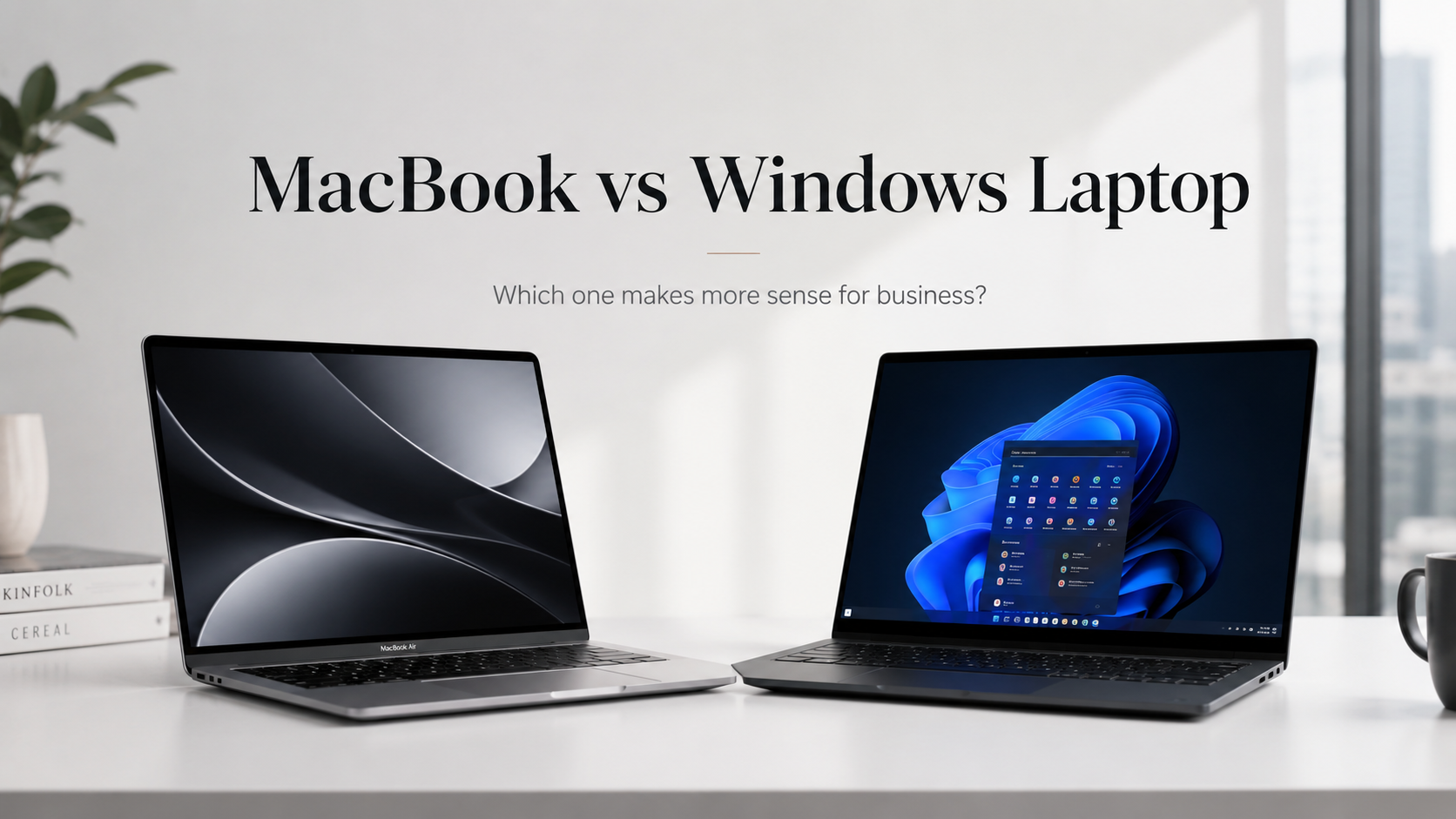
For many businesses, buying laptops is not just a technology decision. It is a productivity decision, a cost decision, and in many cases, a long-term investment decision.
The common question is simple: should a business buy MacBooks or Windows laptops?
The answer depends on the type of work, the team’s needs, the software used, and the value the company expects over time. Both options can work well, but for many business owners, executives, creatives, consultants, and professional teams, MacBooks offer a strong case.
Performance That Feels Consistent
In business, a laptop should help people work without unnecessary delays.
MacBooks are known for smooth performance, fast startup, strong battery life, and a clean user experience. For daily business tasks such as emails, reports, presentations, video calls, spreadsheets, browsing, and client communication, a MacBook can feel reliable and easy to use.
This matters because slow devices do not only waste time. They interrupt focus.
For teams that need dependable machines for everyday work, the MacBook Air can be a strong choice. For heavier work such as design, video editing, development, and advanced creative tasks, the MacBook Pro may be more suitable.
Long-Term Value Matters
Many businesses compare laptops by the buying price alone. But the real cost of a device is not only what you pay on day one.
A cheaper laptop may look affordable at first, but if it becomes slow quickly, needs frequent repairs, has weak battery life, or must be replaced sooner, it can cost the business more over time.
MacBooks are often chosen because they hold value well, last long, and remain useful for several years when properly maintained. For a company, this can make them a better long-term investment.
Security and Simplicity
Businesses handle important information every day. This includes contracts, client details, financial documents, passwords, proposals, and internal communication.
MacBooks come with strong security features such as Touch ID, built-in encryption, secure software updates, and privacy controls. This gives companies more confidence when staff are working with sensitive information.
For many teams, another advantage is simplicity. The macOS experience is clean, stable, and easy to navigate. This can reduce everyday frustrations and help employees focus more on work.
When Windows May Still Make Sense
Windows laptops can still be the better choice for some businesses.
If your company depends on certain industry-specific software that only runs well on Windows, then a Windows laptop may be necessary. Some accounting, engineering, manufacturing, or government systems may also be built around Windows environments.
Windows laptops also offer a wider range of budget options. For teams that only need basic entry-level machines, this can be an advantage.
The best decision is not about choosing what is popular. It is about choosing what fits the work.
Choosing the Right Device for Each Role
A business does not have to buy the same laptop for every employee.
Executives, managers, sales teams, designers, finance teams, developers, and admin staff may all have different needs.
For example, a MacBook Air can work well for office users, managers, consultants, and business owners who need a light, fast, and reliable machine. A MacBook Pro is better for professionals who need more power for creative or technical work.
The goal is to match the device to the role.
Final Thoughts
MacBooks and Windows laptops can both serve business users well. But for companies that value performance, security, design, battery life, and long-term value, MacBooks are a strong option.
The right laptop should not only work today. It should support the business for years.
At iStore Kenya, we help businesses choose the right MacBook for their teams, based on work needs, budget, and long-term value.
Visit iStore Kenya at Bazaar Plaza, Floor M1, Unit 2, Nairobi, or shop online at www.istorekenya.com.